
What B2B video production actually looks like in 2026.
36% of the analyzed sample is classified at production Level 3–5. Short-form video leads this snapshot’s composite ranking of production investment, breadth, recency, and volume.
About this analysis
These findings describe the content in the MarketScale production dataset, not the entire B2B market. The production-level distribution covers 1,000 pieces classified all-time in this snapshot. Format rankings and weekly findings cover Aug 10–Aug 16, 2026.
Rankings combine production investment, breadth, recency, and volume. Credibility and impact scores are analytical indicators, not observed buyer conversion rates or evidence of sales lift. Use them to plan tests, then measure qualified inquiries and pipeline.
Why this matters
Trust in B2B has moved from the analyst to the peer
Buyers no longer take an authority’s word for it. They look for people like them, and they weigh practitioner experience over a vendor’s polish. That is the shift that makes expert-led, real-world content credible.
people “like me” and peers now rank among the most-trusted sources of information.
Edelman Trust Barometer, 2025
buyers increasingly trust peer reviews and practitioner feedback over analyst reports in early evaluation.
Demand Gen Report
Our read: trust has moved peer-to-peer, which is exactly what expert-led UGC delivers. It is why the credibility signals below, led by operational specificity and a named, credible source, out-earn polish alone.
The format leaderboard
Ranked by production investment, breadth, recency, and volume
Customer story leads on the composite score; everything else is more concentrated. The bar shows the composite score and the trend tag shows which way each format is moving. Open any row for its volume and craft level.
Volume share
17%
58 of records
Mean production level
1.69
1 lo-fi → 5 cinematic
Example
[name] Update
Single 30-second vertical social clip from one short source video with branded text overlays, captions, library music, and light stock b-roll, standa
Production investment
The middle is the market
64% of B2B video stays lightweight (Level 1–2). 34% lands at the deliberate middle (Level 3), and 2% reaches high-craft production (Level 4–5). Most teams invest, but few go cinematic.
17
pieces reach high-craft production (Level 4–5), the real investment ceiling.
Credibility signals
What earns the most credibility shows up the least
Operational specificity does the most to move a B2B buyer, yet it shows up far less often than the most common formats. The signals that change minds are the ones companies produce least.
That gap is the opportunity: where a signal matters far more than it appears, that is what to make more of.
The craft underneath
What “real production investment” actually means
Higher production levels aren’t one thing. They’re a stack of craft decisions. These are the choices that show up most across the B2B field, ranked by how often they appear and how many formats they touch.
Custom motion graphics & branding
across 18 formats
Multi-source narrative assembly
across 17 formats
Audio mixing & sound quality
across 18 formats
Talking head / interview editing
across 18 formats
Multi-format delivery
across 7 formats
Chapter structure & navigation
across 13 formats
The pattern: the craft that scales (clean interview editing, sound, motion graphics, branding) travels across nearly every format. The craft that doesn’t scale (onsite complexity, multi-source assembly) stays rare, and that’s exactly where high-production formats separate from the field.
The playbook matrix
What to make, for whom, at which stage
Top-of-funnel stages have the most format options; retention and expansion stay thin. Cell intensity tracks how many formats fit each pairing.
| Practitioners | Customers | Internal experts | Executives | Partners | |
|---|---|---|---|---|---|
| Awareness | Field insightShort-form videoSocial proof post | Customer storySocial proof post | Analyst-style explainerPodcast episode | Executive POVVertical market commentaryAnalyst-style explainer | Partner perspectiveVertical market commentary |
| Education | Practitioner Q&AField insightInternal expert breakdown+1 more | Customer storyOnsite customer interview | Internal expert breakdownAnalyst-style explainerWebinar clip | Expert interviewWebinar clip | Partner perspectiveProduct walkthrough |
| Consideration | Field insightPractitioner Q&AExpert interview | Onsite customer interviewCustomer storySales enablement clip | Executive POVExpert interview | Partner perspectiveCustomer story | |
| Decision | Sales enablement clipField insightInternal expert breakdown | Onsite customer interviewSales enablement clipCustomer story | Sales enablement clipProduct walkthrough | ||
| Expansion | Customer storyOnsite customer interview | Internal expert breakdownProduct walkthroughWebinar clip | |||
| Retention | Practitioner Q&AInternal expert breakdown | Customer storyEvent recapWebinar clip |
Five plays to run
Turn the data into a production plan
Common questions
What the data points to
Which B2B video format performs best in 2026?
Short-form video leads the field. It scores highest on the composite of production investment, breadth, recency, and volume, while every other format stays more concentrated. Expert interviews and executive POV carry high production craft but far narrower reach.
How much B2B video is actually high-production?
Only 2% of B2B video reaches high-craft production (Level 4–5). The bulk of the market, 64%, stays lightweight (Level 1–2), and 34% lands at the deliberate middle. Most teams invest something, but few go cinematic.
What makes a B2B video credible to buyers?
The highest-scored credibility signals are not always the ones produced most in this sample. Named creator / expert source scores 89/100 on impact yet shows up far less often than lower-impact signals. Operational specificity and a named, credible source are useful hypotheses to test alongside polish. It tracks with where trust sits now: in Edelman’s 2025 Trust Barometer, peers and people “like me” rank among the most-trusted sources, so a real practitioner on camera tends to carry more weight than a brand-voice claim.
What separates high-production B2B video from the rest?
It’s a stack of craft choices, not one thing. The craft that scales (custom motion graphics & branding, clean interview editing, and sound) travels across nearly every format. The craft that doesn’t scale, like onsite production complexity and multi-source assembly, stays rare, and that’s where high-production work pulls away from the field.
Where in the funnel should B2B teams invest in video?
Top-of-funnel stages have the most format options, while retention and expansion stay thin. The clearest opportunity is matching the format to the stage and creator: customer and practitioner formats for consideration and decision, executive and partner formats for awareness.
How do I turn these findings into a content plan?
Start where impact is high and supply is thin: pick one or two under-produced credibility signals and build a repeatable format around each, then match it to the funnel stage and creator type it serves. The companion guide at /best-practices/ugc-for-b2b shows the latest available format analysis, and the platform at /platform is built to capture the work from the people who already have the expertise.
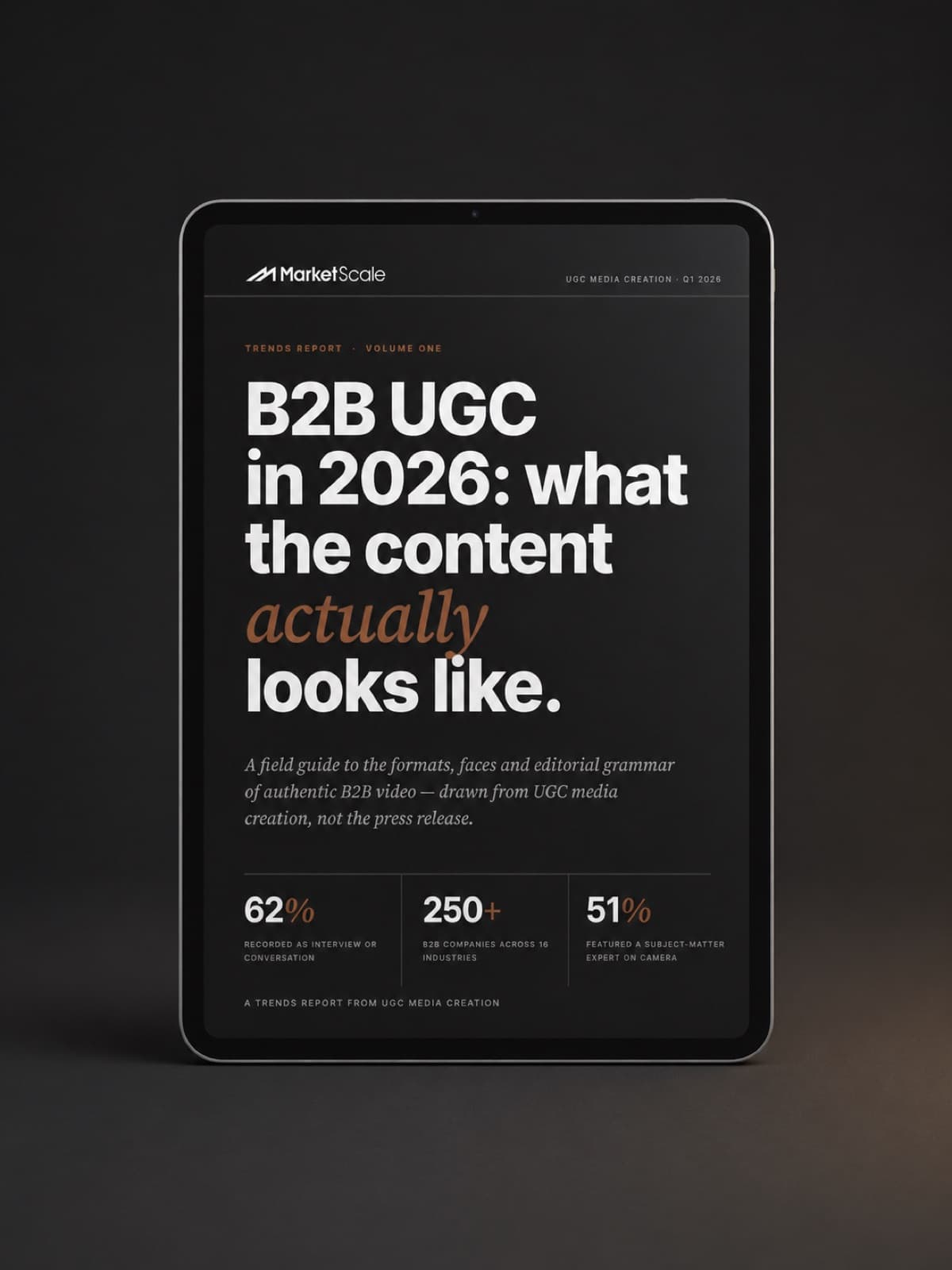
Want the full report as a PDF?
The companion PDF packages this snapshot (the leaderboard, the matrix, and all five plays) for sharing with your team. Enter your name and work email to download it.
Build a real UGC program
Related reading from the Blog
Underground mining equipment: what's driving the market's next decade
Underground mining equipment demand is shifting fast as deeper deposits, electrification, and automation reshape a $17.9 billion global market.
Mihai Cotocel's AdverseMe Announces September 1 Launch and KYCK Partnership
AdverseMe launches its screening platform Sept. 1, 2026, and names KYCK as a partner using its engine for counterparty due diligence.
Fortis Re-Engages MarketScale to Support Contractor VAR Channel Expansion
Fortis has renewed its partnership with MarketScale for content supporting a new Contractor Value-Added Reseller channel for its roof reconditioning programs.